From Empty Warehouses to Worker-Owned Factories: The Co-op Supply Chain Quietly Reshaping Rural America
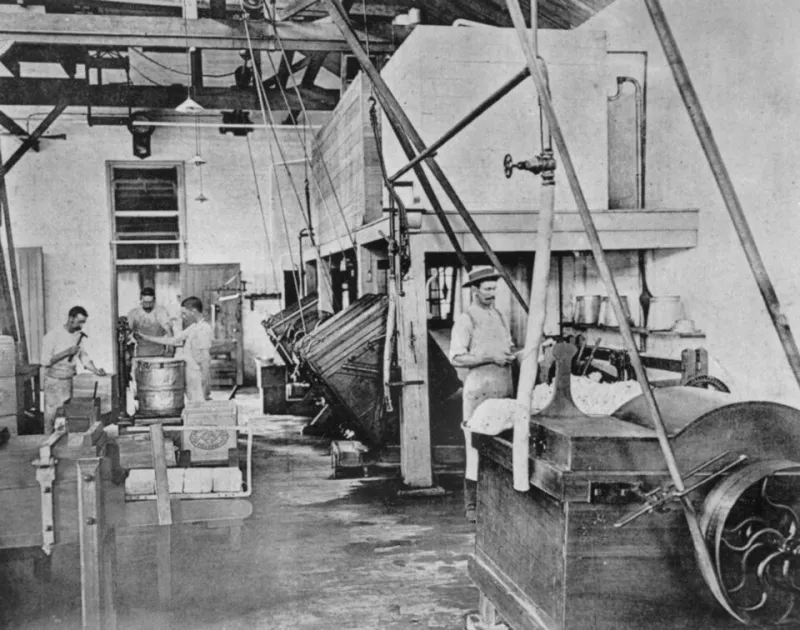
Photo: Unknown, Public domain, via Wikimedia Commons
The town of Rockford, Illinois once anchored one of the most productive manufacturing corridors in the American Midwest. At its peak, the city's machine tool and hardware industries employed tens of thousands of workers and supplied components to manufacturers across the country. By the early 2000s, that industrial base had been substantially dismantled—relocated offshore or consolidated into distant facilities optimized for scale rather than community continuity.
Rockford is not exceptional. Across post-industrial America, from the mill towns of western North Carolina to the auto-dependent communities of Michigan and Ohio, the story is a familiar one: manufacturing left, and the economic infrastructure that depended on it eroded alongside it. When global supply chains seized during the pandemic years, revealing just how dependent American production had become on distant and fragile logistics networks, these communities felt the consequences acutely.
But something else has been quietly developing in these same towns—a model of industrial organization that prioritizes resilience over efficiency and community ownership over shareholder returns. Worker-owned manufacturing cooperatives and member-governed supply networks are beginning to fill the spaces that conventional industry vacated, and their early results deserve serious attention.
The Structural Problem That Cooperatives Are Solving
Conventional supply chain design, as refined over several decades of globalization, optimized relentlessly for cost reduction. Components were sourced from the lowest-cost producer regardless of geography, logistics were centralized to capture scale efficiencies, and inventory was held as lean as possible to minimize carrying costs. This model produced remarkable price deflation for consumers while concentrating economic activity in fewer, larger facilities.
The vulnerabilities embedded in this architecture became unmistakable between 2020 and 2022. Port congestion, container shortages, factory shutdowns in Southeast Asia, and trucking capacity constraints cascaded into shortages of goods ranging from semiconductor chips to household cleaning products. American manufacturers discovered that their supply bases were simultaneously global and fragile—optimized for steady-state conditions but poorly suited to disruption.
Cooperative supply chains are structured differently from the ground up. Because member-owners have a direct stake in the network's continuity rather than its quarterly margin performance, they tend to make different trade-offs. Redundancy is valued. Local sourcing is preferred when feasible. Investment in member capacity is treated as infrastructure rather than overhead.
Real Models, Real Results
The Organic Valley cooperative, headquartered in La Farge, Wisconsin, offers one of the most studied examples of cooperative supply chain durability. Founded in 1988 by a small group of family dairy farmers facing commodity price collapse, the organization has grown into a farmer-owned cooperative with more than 1,700 member farms across 34 states. During the pandemic period, when conventional dairy supply chains experienced significant disruption, Organic Valley's member-governed structure allowed rapid reallocation of production across its network without the coordination failures that plagued larger, investor-owned competitors.
In manufacturing, the Evergreen Cooperatives of Cleveland, Ohio represent a different but equally instructive model. Anchored by a worker-owned commercial laundry, a greenhouse operation, and an energy services company, the Evergreen network was designed explicitly to create employment and retain economic value within a defined urban geography. The cooperatives source from one another where possible and sell preferentially to large anchor institutions—hospitals, universities—that have committed to local procurement. The result is a closed-loop economic circuit that keeps revenue cycling within the community rather than flowing outward to distant corporate headquarters.
In rural Appalachia, Berea College's student-operated craft cooperatives have demonstrated that small-scale, worker-governed manufacturing can sustain quality and market access across generations—an existence proof that cooperative production is not inherently limited to low-complexity goods.
Why the Worker-Ownership Model Builds Differently
The governance structure of a worker-owned cooperative produces operational behaviors that differ systematically from investor-owned firms, and those differences have direct supply chain implications.
Worker-owners cannot be relocated. When a private equity firm acquires a manufacturing facility, the calculus of closure or consolidation is purely financial—if production can be concentrated elsewhere at lower unit cost, the local facility becomes expendable. Worker-owners, by contrast, have both economic and social stakes in their facility's continuity. They live in the community, their families depend on the wages, and their ownership stake has value only as long as the enterprise operates. This creates a strong structural bias toward investment in local capability rather than footprint rationalization.
This same dynamic shapes supplier relationships. A worker-owned cooperative that sources materials locally is not merely making an ethical choice; it is reinforcing the economic ecosystem on which its own members depend. When a co-op factory buys steel from a regional supplier rather than an import broker, it is making a bet that the regional supplier's survival serves its own long-term interests. That alignment of incentives produces a form of supply chain solidarity that has no analog in conventional procurement strategy.
The Capital Challenge and How Communities Are Addressing It
The most significant structural obstacle facing cooperative manufacturing is access to startup and expansion capital. Conventional venture investment is poorly suited to cooperative enterprises, which cannot offer equity stakes to outside investors without diluting member control. Traditional bank lending often requires collateral that early-stage co-ops lack.
A growing ecosystem of cooperative-specific financial institutions is beginning to address this gap. The National Cooperative Bank, the Shared Capital Cooperative, and a network of community development financial institutions (CDFIs) have developed lending products tailored to cooperative structures. Several states have enacted legislation enabling cooperative-friendly investment vehicles that allow community members to invest in local cooperative enterprises without triggering securities regulations designed for conventional equity markets.
Philadelphia's Kensington neighborhood, long associated with industrial decline, has seen several worker cooperative startups access capital through a combination of CDFI loans, city economic development grants, and member equity contributions. The resulting enterprises are small by conventional manufacturing standards but meaningful at the neighborhood scale—creating stable employment in communities where stable employment has been scarce.
A Model for Durable Commerce
The cooperative supply chain is not a panacea for the structural challenges facing post-industrial American communities. It does not offer the scale economies of global manufacturing or the capital velocity of venture-backed enterprise. What it offers instead is something different and, in certain contexts, more valuable: durability, local accountability, and a governance structure that aligns institutional incentives with community welfare.
At MyKoperasi, the cooperative supply chain represents one of the most compelling expressions of community commerce in practice. When workers own the factory, when farmers govern the distribution network, and when members set the terms of trade, the resulting enterprise is not merely a business—it is a piece of shared infrastructure, as essential to community function as a road or a school.
The warehouses are not all empty. Some of them are being filled again, by people who own them together.