The Local Supply Chain Revolution: How Independent Food Businesses Are Cutting Costs Through Collective Buying
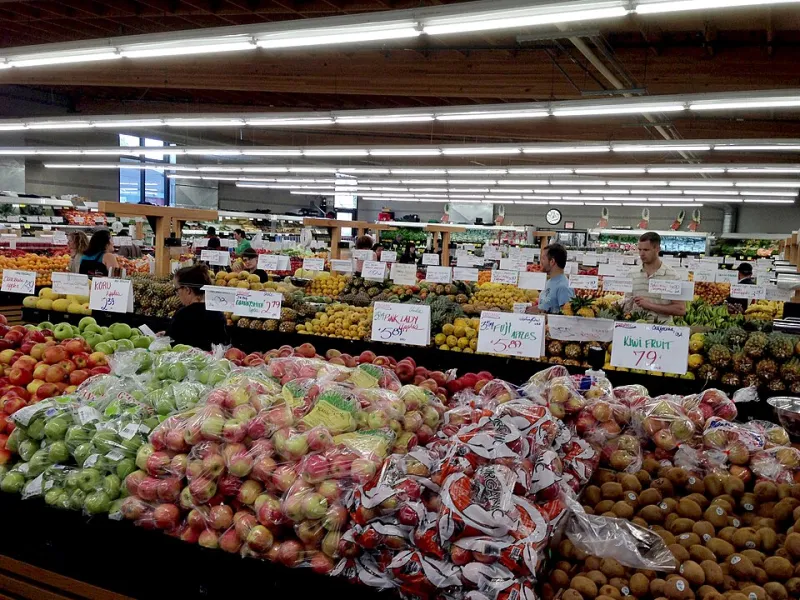
Photo: Smerdis, CC BY-SA 4.0, via Wikimedia Commons
There is a persistent myth embedded in American food retail: that size determines survival. That Walmart's supply chain efficiency, Sysco's distribution network, and Amazon Fresh's algorithmic pricing represent an insurmountable structural advantage over the independent grocer, the family-owned restaurant, and the neighborhood market.
That myth deserves a serious reexamination.
Across the country, a quiet but consequential shift is underway. Independent food operators — individually too small to negotiate meaningful terms with national suppliers — are pooling their purchasing power through cooperative networks, cutting procurement costs by double-digit percentages, and, in several cases, outperforming their corporate competitors on the dimensions that matter most to modern consumers.
The Problem With Going It Alone
For an independent restaurant or small grocery chain, the economics of supplier relationships have historically been punishing. National distributors price their services according to volume. A single restaurant ordering 200 cases of canned tomatoes per month occupies a fundamentally different negotiating position than a regional chain ordering 20,000. The gap in pricing, delivery priority, and contract flexibility is not incidental — it is structural.
The consequences of this imbalance extend well beyond unit costs. Independent operators frequently carry higher minimum order requirements, face less favorable payment terms, and have limited recourse when supply disruptions occur. During the pandemic-era supply chain breakdowns, these vulnerabilities became acute. Businesses that relied on a single national distributor found themselves unable to source basic ingredients for weeks at a time, while larger chains with diversified logistics networks absorbed the disruption more readily.
The solution, for a growing number of operators, has not been to grow larger. It has been to grow together.
How Cooperative Purchasing Networks Actually Work
A cooperative purchasing network in the food industry operates on a straightforward principle: member businesses aggregate their demand, negotiate collectively, and share the resulting cost savings in proportion to their participation. The mechanics, however, vary considerably depending on the network's structure and focus.
In the most established models — such as those operated through regional food co-op federations and independent retailer buying groups — a central administrative entity manages supplier contracts, tracks member orders, and distributes volume rebates. Members retain full operational independence while benefiting from pricing structures previously available only to large-scale buyers.
NACO (the National Cooperative Grocers association) and similar organizations have demonstrated the model's durability over decades. Independent natural food retailers affiliated with buying cooperatives have consistently maintained gross margins competitive with regional and national chains, despite operating at a fraction of the scale.
More recently, technology has accelerated the formation of these networks among food service operators — a segment where cooperative purchasing has historically been less organized than in retail. Platforms designed specifically for restaurant group purchasing now allow operators in the same metropolitan area to align their ordering cycles, share supplier relationships, and coordinate on local sourcing contracts in ways that were logistically impractical a decade ago.
Case Studies in Collective Efficiency
In the Pacific Northwest, a coalition of independent restaurant operators formalized a cooperative purchasing arrangement with regional produce distributors in 2021. Within eighteen months, participating businesses reported average procurement cost reductions of 15 to 18 percent on fresh produce categories — a result that materially improved margins in an industry where a two-point improvement in food cost percentage represents a significant financial event.
The arrangement also produced secondary benefits that participants had not fully anticipated. Because the network's aggregate volume justified direct relationships with regional farms, member restaurants gained access to higher-quality, fresher product than the standard distributor catalog offered. Several operators noted that the quality differential became a marketing asset, allowing them to credibly promote local sourcing without absorbing a premium cost.
In the Midwest, a network of independent grocery operators affiliated with a regional buying cooperative has used collective contracts to compete directly with discount grocery chains on staple categories — a competition that most analysts would have dismissed as futile given the scale gap between the two sides. By concentrating their combined volume on a smaller number of preferred suppliers and eliminating the margin layers associated with national distribution intermediaries, the cooperative's members have narrowed the price gap to within a range that their service quality and community relationships can bridge.
Technology as the Coordination Layer
Perhaps the most significant development accelerating the growth of hyperlocal supply networks is the maturation of software tools designed specifically for cooperative procurement coordination. Where earlier generations of buying groups relied on manual order aggregation and phone-based negotiation, current platforms allow real-time demand signaling, automated compliance tracking, and dynamic contract management.
For food service operators in particular, these tools address a longstanding coordination problem: restaurant ordering patterns are highly variable, making it difficult to commit to the volume forecasts that supplier negotiations require. Modern cooperative platforms address this by creating rolling demand pools — aggregating probabilistic order data from multiple members to generate volume commitments that individual operators could not make independently.
The practical effect is that a network of twenty independent restaurants can present a regional supplier with the same kind of predictable, committed volume that a national chain account represents. The supplier gains reliability; the cooperative members gain pricing.
The Broader Implication for Independent Business
The food industry's experience with cooperative supply chains carries lessons that extend well beyond grocery aisles and restaurant kitchens. The fundamental challenge that cooperative purchasing solves — the disadvantage of operating at small scale in a market structured around large buyers — is present in nearly every sector of the American economy.
What the food sector's most successful independent operators have demonstrated is that scale is not always the answer. Coordination can substitute for size in ways that preserve the independence, community connection, and operational agility that small businesses offer and that corporate chains, for all their logistical efficiency, cannot replicate.
For the independent operator considering a cooperative purchasing arrangement, the entry point has never been more accessible. Regional networks, national associations, and purpose-built technology platforms have collectively lowered the organizational friction that once made collective buying the exclusive province of large, well-resourced cooperatives.
The competitive advantage that community commerce offers is not theoretical. It is measurable, replicable, and, for the businesses that have embraced it, increasingly essential.